


Activities for 6-Month Olds
October 2, 2025
Jordyn Koveleski Gorman

Last Updated on January 21, 2026 by Jordyn Koveleski Gorman
This page contains affiliate links. We will receive a commission on qualifying purchases using these links.
In their first few months, babies see the world primarily from their bellies and backs. Even when you can’t see it, they’re hard at work strengthening muscle groups necessary for sitting, crawling, and eventually walking.
Then around 6 months, everything changes!
All of your baby’s hard work has paid off. Your baby’s neck control is better, and their trunk is more stable. Your baby is now able to play on their tummy while using their arms to interact with objects. Soon, your baby will learn how to sit upright, first with help, and then on their own for longer periods of time. This frees up the use of baby’s hands, which can then be used to interact with toys. Game changer.
There’s a whole new world of sights, sensory experiences, and play activities for your little one to explore. Wake windows are also starting to increase by this age, as most babies are now taking three naps a day. This allows for more active play time in between naps, which means more opportunities for language, social engagement, and cognitive development!
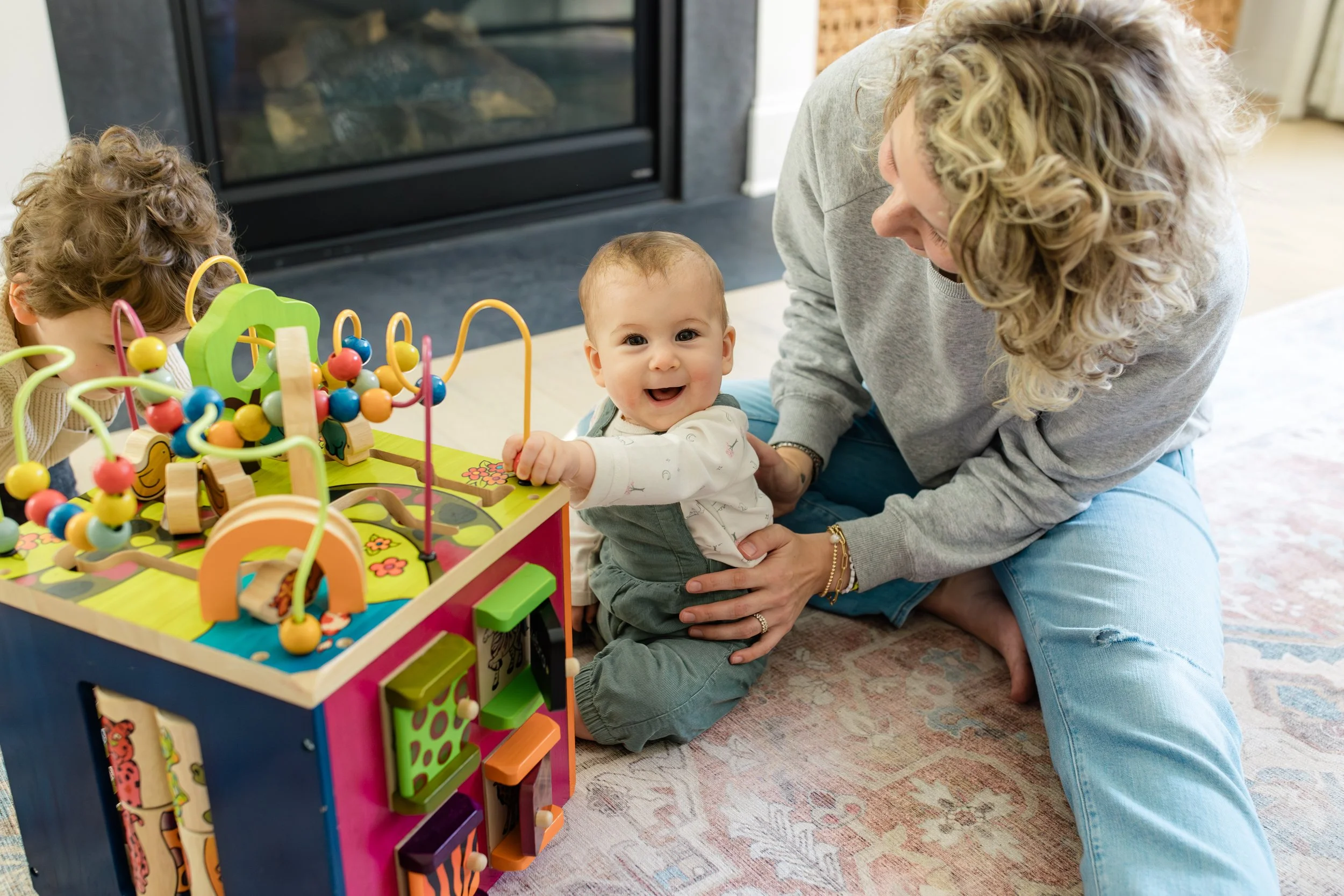
6 month milestones
Supporting your baby’s development starts with knowing what’s expected at any given age. For six month olds, we expect to see developmental milestones such as:
- Shouting and vocalizing to get attention
- Starting to babble a variety of sounds (ba, ma, ga, da)
- Smiling and laughing socially
- Beginning to interact with objects functionally
- Responding vocally when you talk and sing
- Stopping for “no” or when name is called
- Trying to imitate raspberries/some sounds
- Trying to imitate movements like pushing a tower/banging a drum
- Attending to pictures/books for short intervals
- Sitting for short periods of time while supported
- Beginning to sit without support
These are just a few of the milestones we look for in 6 month olds. You can check and see where your baby is at and where they may need extra support by downloading our free milestone checklist for ages 0-36 months.
Developmental activities for 6 month olds
Toys are becoming more interesting by the day for most babies at this age, but so are your wooden spoons, TV remotes, and the tags on literally any object. This makes it easy to engage with your baby in so many ways!
Remember that play is one of the best ways to help your little one learn and grow. Social play in particular helps your baby build cognitive skills and learn to solve real-world problems for years to come! (1)
Here are our top 5 activities for 6 month olds:
-
Stacking block towers: Stack several blocks (we like these soft ones for no ouchies!), modeling “up” each time you stack a block. Encourage baby to reach toward the tower and knock it down. Model “boom” and “crash” when the tower falls down!
-
Bring on the music! Babies love music and at 6 months, they can start making music of their own! Maracas that baby can grasp, pass back and forth between hands, and shake to the music are a fun first introduction to musical instruments. Keep your language simple and say “shake, shake, shake” as you play. These bongo drums can be used during tummy time or while sitting upright and make drum sounds. Model simple action words like “bang,” “tap” and “boom” while you play. This is not only working on cause and effect, but also on early imitation skills. Remember, gross motor imitation comes before vocal imitation!
-
Fill and spill: Filling baskets and other soft containers with baby-safe toys is a great way to encourage independent exploration and work on early container play. Babies love to put objects in, take them out, and dump containers! Model simple function words like “in,” “out,” “dump” as baby explores the toys. Some favorite fill and spill type toys also encourage functional play, such as Melissa and Doug’s toolbox, soft purse, and grocery bag. Show your baby how to “drill” the wood, talk on the soft phone, and “munch” on the carrot. Other fill and spill toys have soft animals that make animal sounds when you squeeze them, like our favorite hungry pelican! These are great for working on sound imitation. Model the animal sounds for baby and remember to pause to see if baby will make an attempt!
-
Beep beep! Toy cars, both big and small, are a great way to introduce things that go. This colorful car is a excellent for new sitters and will be played with for years to come! There is so much that you can do with it and it grows with your child. Baby can sit supported in the car and practice cause and effect by beeping the horn (model “beep beep!”), turning the steering wheel, and moving along to the music. Model waving “bye bye” as your baby “drives” away. Soft cars that have a pull-back function are engaging and enticing once baby starts trying to crawl. Model function words such as “go” and “stop” while you play!
-
Shared book reading: Now’s the age that you can really start diving into board books. Read face-to-face with baby so that she can see your facial expressions and begin to turn the pages. Babies have short attention spans, so use books with textures, sounds, big flaps, and buttons to increase engagement. Give simple directions such as “push” or “touch” and remember to pause for several sections so that baby can begin to respond. See my favorite books for 6 month-olds here!
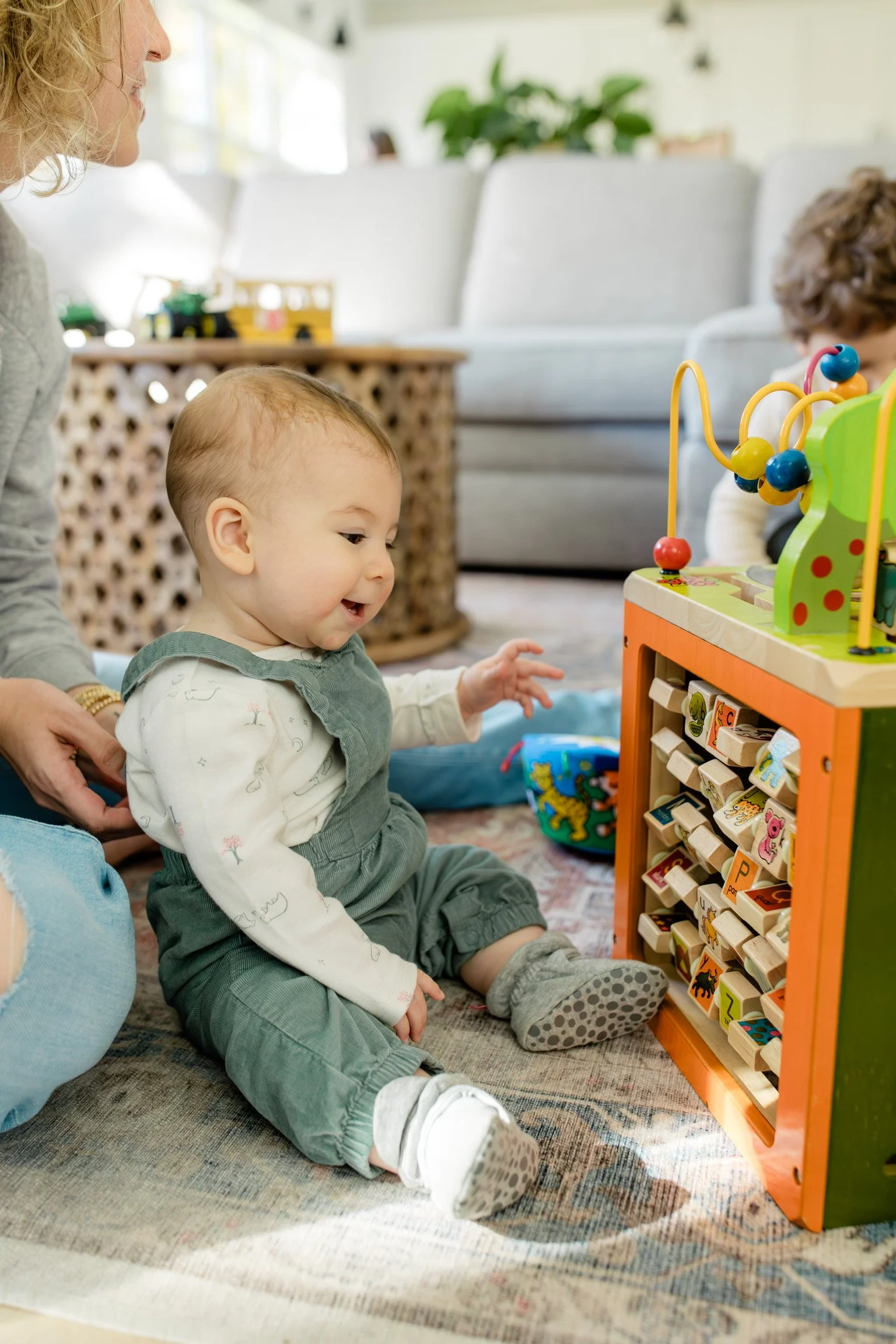
Sensory activities for 6 month olds
Babies’ senses are in high gear from birth, but now that they’re beginning to explore the world in an upright position, the world is exploding before their eyes. Sensory play is all around us, and your
Some of our favorite sensory-focused activities for 6 month olds are:
- Give your little one a horsey ride! Lay on your back, tuck your knees, and place baby on your shins. Gently bounce them up and down and sing them a song! There are lots of horse-themed nursery rhymes to choose from. You can also do this while sitting on the couch, bouncing baby on your knee. This provides baby sensory input and motivates them to make eye contact and communicate with you!
- Enjoy some water play! Pour water onto a baking sheet, enough to cover the bottom, and have baby sit or lay in front of it. Show them how to bat and splash the water. It might be messy, but it’s only water! Add your little’s favorite bath toys to the tray to help entice them.
Crafts for 6 month olds
Activities that involve reaching, transferring objects from one hand to another, and grasping objects are really starting to interest your baby. Crafts are an amazing developmental activity because they offer all of the above!
A few of our favorite crafts for 6 month olds include:
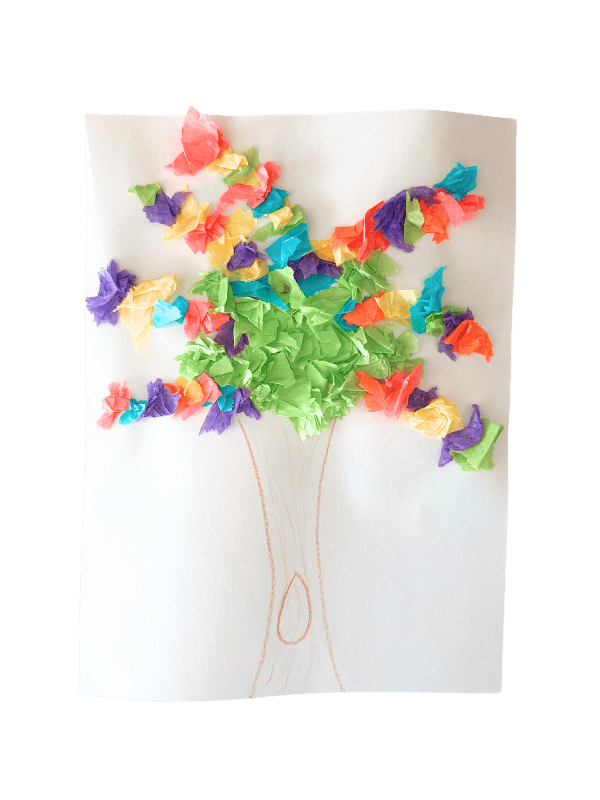
Tree painting:
- Use paint or crayons/markers to draw and color in a tree on light colored construction paper.
- Let your little one help you tear smaller pieces off of the tissue paper (this is especially great for young babies).
- Make dots or lines of glue on the tree branches.
- Model using pincer fingers to pick up the tissue paper pieces and place them on the glue dots.
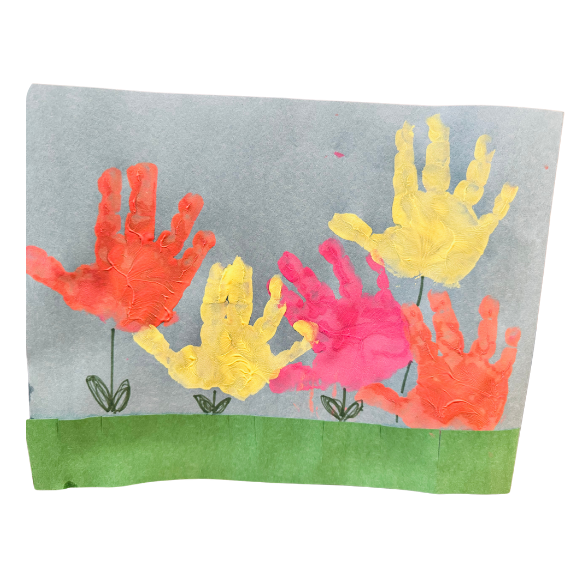
Handprint flower garden:
- To prep this craft, pour different colors of washable paint on separate paper plates.
- Dip your little one’s hand in the different colored paints and put their handprints on a piece of construction paper (3-5 handprints per sheet of paper).
- Draw stems from handprints down to the bottom of the page to create a garden.
- Optional addition: Add in grass, a sun, and anything else you want to add to the flower garden scene!
Gross motor activities for 6 month olds
Baby is really starting to adjust to the world being upright for a change, and that’s a major gross motor win! Things are taking off from here, and before you know it, you’ll be chasing your little one around.
Our favorite activities that support gross motor development for 6 month olds are:
- Sit on the floor with baby between your outstretched legs. Put a toy on the outside of your legs so that your baby has to reach over you to grab it. You can do this with their favorite toys! A few good options include putting a ring stacker in front of your baby and the rings outside your legs, or start a block tower and leave the extra blocks on the other side.
- Take your little one on a laundry basket ride! Pop baby in a laundry basket or an empty diaper box and add some clothes around their hips for comfort and support. They’ll likely grab onto the sides and move all around, exploring this new “spaceship” they’re in. Once they’re adjusted, take them on their first ride! Add in language like “Stop!” and “Go!” and “Ready, set, go!” to get them excited.
Fine motor activities for 6 month olds
Right now, your baby is grasping objects that fit in their fists—but did you know by the time they’re around 9 months old, they’ll be using their pointer finger and thumb to grasp small items, like Cheerios?
A few of our favorite fine motor activities to do with your 6 month old are:
- Lay a burp cloth or washcloth flat on the ground within baby’s reach. Simply grab the cloth from the floor, then let it go in the air, saying “whoosh!” Set the cloth back in place in front of baby and wait for them to imitate you. This motion encourages baby to use their raking grasp, which is especially important for developing self-feeding skills.
- Balloons are absolutely mesmerizing to infants. Pick up a couple helium-filled balloons at your local dollar store and gently tie them on your baby’s wrists. They will love watching the balloons bounce around as they wiggle and move their arms. Then, you can swap the balloons to their feet and encourage them to kick, kick, kick!
Need more play ideas?
As your little one grows, we’ve got your back when it comes to play time. The Eat Play Say team specializes in supporting parents and their children in growth and development!
Don’t forget: every activity you do with your little one supports their growth! You don’t have to start fresh every month or through each era because every stage is another building block on top of the one before.
You’re doing a great job. Have you seen the way your baby looks at you?!
If you liked the activities in this post, you will love our Playbooks—more than 100 age-appropriate, developmentally supportive ways to play with your child using only what you have at home!
Sources:
- Center on the Developing Child at Harvard University (2011). Building the Brain’s “Air Traffic Control” System: How Early Experiences Shape the Development of Executive Function: Working Paper No. 11.
Leave a Reply
OTHER POSTS YOU MAY LIKE:



MS, SLP
Founder of Eat Play Say, Speech-Language Pathologist, Feeding Specialist, Play Expert, Mom of 3
Jordyn Koveleski Gorman
SPECIALIZES IN: Infant and toddler speech-language, play, and feeding development, and curating a team that provides expert help that feels like a reassuring text from that one mom friend
EDUCATION: Jordyn received her BS in Speech-Language Pathology from Bloomsburg University and her MS in Speech-Language Pathology from Towson University
FAVE PARENTING FIRST: “The first true smile, it’s the sweetest!”

MS, CCC-SLP, CBS, IBCLC
Speech-Language Pathologist & Feeding Specialist, Certified Breastfeeding Specialist, International Board Certified Lactation Consultant
Jessica Nicholson Cocca
SPECIALIZES IN: Breast and bottle feeding, tongue ties, oral motor dysfunction, starting solids, infant and toddler speech, treating oral motor disorders
EDUCATION: Jessica received her BS in Communication Sciences and Disorders from Pennsylvania State University in 2015 and her MS in Speech-Language Pathology from Towson University in 2017
FAVE PARENTING FIRST: “Baby’s first wave! What a fun first communication gesture!”

MA, CCC-SLP, CLC
Speech-Language Pathologist, Certified Lactation Counselor
Jennifer McFarlin
SPECIALIZES IN: Breast and bottle feeding, tongue ties, starting solids, infant and toddler speech development
EDUCATION: She received her BS in Speech-Language Pathology from Ball State in 2014 and a MA in Speech-Language Pathology from Ball State in 2016.
FAVE PARENTING FIRST: “My favorite baby’s first is their first true smile that just warms your soul knowing they are smiling at you. My other favorite is their first word. I love watching their language explode!”

MS, CCC-SLP
Bilingual Speech-Language Pathologist
Nicole La Petina Kelly
SPECIALIZES IN: Bilingual development (Spanish-English), supporting multilingual families, infant and toddler speech
EDUCATION: She received her BA in Communication Sciences and Disorders and in Spanish from the University of Wisconsin-Madison in 2014 and her MS in Speech-Language Pathology with an English-Spanish Specialization from Marquette University in 2016.
FAVE PARENTING FIRST: “It’s the first slobbery kisses for me!”

RDN, LD
Licensed Registered Dietitian
Kimberly Vede
SPECIALIZES IN: Infant and pediatric nutrition including breastfeeding, formula feeding, and starting solids. She also specializes in prenatal and postpartum nutrition.
EDUCATION: She received her BSc in Biology in 2014 from Life University, and her BSc in Dietetics from Life University in 2019.
FAVE PARENTING FIRST: ”The first time they say ‘mama!’”


This checklist was created with input from a Speech-Language Pathologist, Occupational Therapist and Physical Therapist and has been downloaded over 20,000 times by parents worldwide. Learn the important milestones to pay attention to, and keep it in your digital back pocket during the baby + toddler years!
Comprehensive Milestone Checklist for gross motor, fine motor, and speech-language milestones for 0-36 months,
DOWNLOAD FOR FREE


