


What is Flat Head Syndrome?
June 11, 2024
Jordyn Koveleski Gorman

Last Updated on May 26, 2026 by Jordyn Koveleski Gorman
This page contains affiliate links. We will receive a commission on qualifying purchases using these links.
You may have seen something on social media or met a baby with a helmet in real life, or maybe you’re concerned that your little one could have a flat spot on their head. One thing I know for sure? The internet can be scary, especially when it comes to conditions like flat head syndrome.
First thing’s first, let’s dispel some misinformation about flat head syndrome. It does not mean that a baby is being neglected. Nope. Hard stop right there.
Research indicates that the frequency of flat spots on the skull in infants could be as high as 46%. (1) That’s right: nearly half of all babies could experience some degree of head flattening!
Flat head syndrome occurs when a baby’s head has flattened on the back or one side. It can be caused by several things. Most commonly, it’s caused by baby’s positioning in the womb, excessive time spent on their back, or as a result of neck tension or tightness (known as torticollis). (2)
You might be thinking, “This stuff didn’t exist when I was a kid! Where did it come from?”
And, believe it or not, that’s not too off base. Awareness of flat head syndrome has increased drastically in recent years, and referrals to speciality clinics have increased significantly, too. (2)
So what’s the deal with flat head syndrome? As a mom to a child who wore a helmet in infancy, I have my own personal experience with this condition. Combined with the expertise of our team’s physical and occupational therapists, we’re going to break it down and hopefully provide some clarity and peace of mind!

Flat head syndrome in infants
In the first few weeks or months of life, you may notice that the side of your baby’s head has developed a flat spot or a lack of rounding in one area (called plagiocephaly) or across the back of the head (called brachycephaly).
You might notice this after also observing that your little one likes to sleep or lay in a certain position, perhaps with their head tilted to one side. Commonly called a “head turning preference,” this can often be the first sign that a flat spot might be forming on your little one’s noggin.
Does your baby have a head turning preference?
Look at your camera roll to see if most of the pictures show your little one looking the same way or with their head in a similar position. That is a good way to determine if your baby might have a head turning preference.
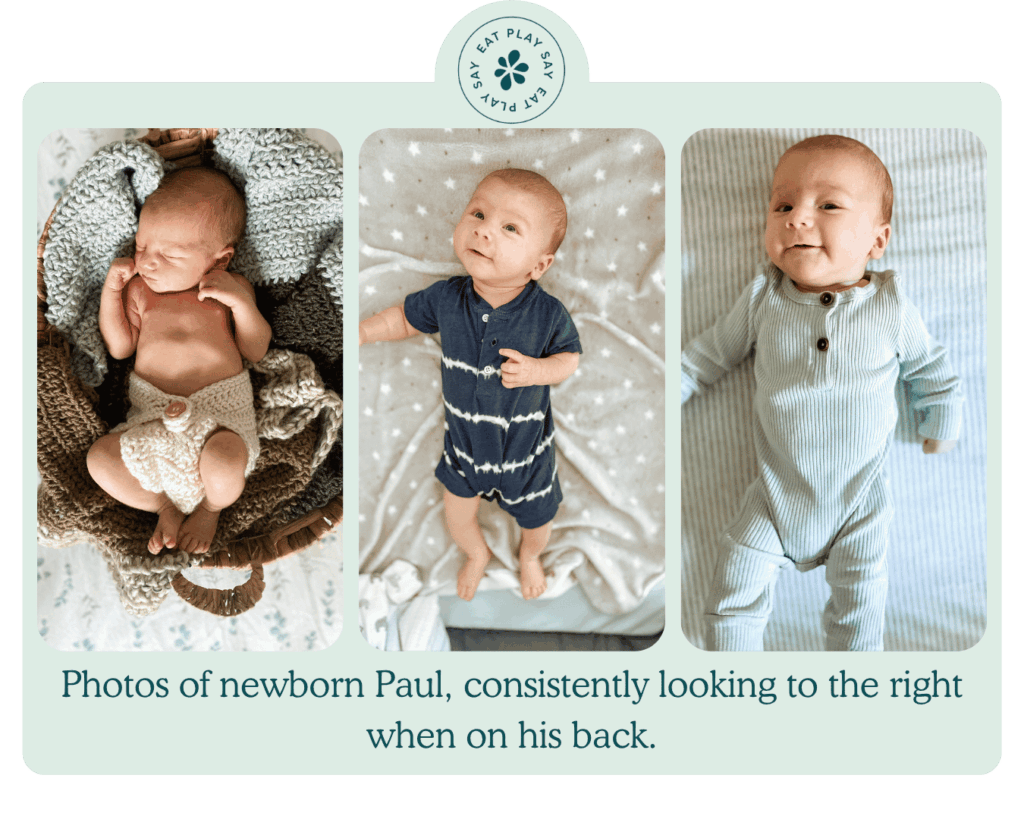
What to do if baby has a head turning preference
If you notice that your little one likes to lay a certain way, feeds more comfortably on one side, or doesn’t seem to enjoy certain head positions (like turning their head in the opposite direction), they may have a head turning preference. These preferences are often due to body or neck tension.
A formal evaluation by a trained physical therapist, occupational therapist, or craniosacral therapist is recommended if these concerns develop. You can also self-refer to Early Intervention for an evaluation, although it is common for there to be a wait. Our team is available for 1:1 virtual consultations in a matter of days.
Working with specialists early on may decrease the risk of further development of a flat spot or may prevent one from forming at all. “Wait and see” is not a recommended approach when it comes to flat spots or developmental milestones.
While you are waiting for a formal evaluation, there are some things you can do to help your little one.
Tips for helping your baby with a head turning preference
- Lay your baby on their side with rolled towels behind them for support. Do this on both sides.
- Motivate your little one to look in the opposite direction by putting wrist and ankle rattles on the arm and leg that you want your baby to look towards. If baby prefers to look to the right, put the rattles on their left arm and leg, and vice versa.
- Place baby on their tummy for short bursts during wake windows. Use a Boppy or a rolled blanket under their chest if they don’t enjoy being directly on the floor. Or even lay them on your forearm. I demonstrate all of this here!
- Wear your baby in a carrier or wrap for some naps and limit time spent in containers when you can (e.g., bouncer, swing, car seat if possible). Turn their head in the carrier so they aren’t always facing the same direction when asleep.
- Alternate positions when feeding your baby. For example, do one feed with baby in the crook of your left arm, and the next feed in the crook of your right arm. Feed in an elevated sidelying position and alternate sides.
- Parents think about tummy time and time spent playing on their back, but often forget that playing with baby in sidelying position is important, too.
Flat head syndrome treatment options
How are plagiocephaly and brachycephaly treated?
As a refresher, plagiocephaly refers to flatness on one spot or side of the head, while brachycephaly refers to flatness across the back of the head. Treatment for both forms of the condition is the same.
Some babies can round out their flat spots through therapeutic exercises under the guidance of a physical therapist, occupational therapist, and/or craniosacral therapist trained in treating flat spots and neck and body tension.
If babies are seen early on (especially before 3-4 months of age), therapy is often incredibly beneficial. Depending on the severity of the flat spot, or the timeline of receiving therapy for head shape, some babies will require a cranial orthotic to fully round out their head.
Research on the efficacy of helmets is limited, although clinical experience points to significant reshaping through the use of helmet therapy.
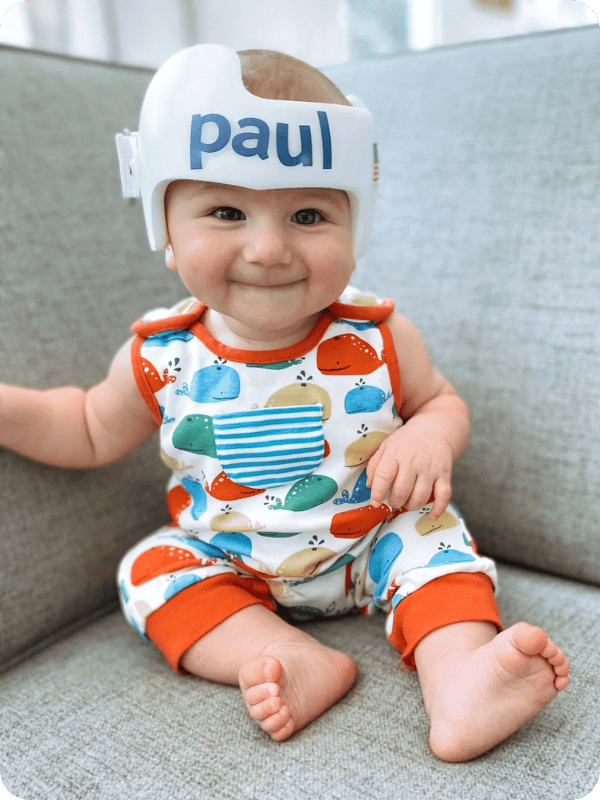
My son, Paul, wore a DocBand cranial helmet from Cranial Technologies as a result of a severe flat spot. There are many orthotics clinics across the US that fit babies for helmets.
Why do flat spots need to be corrected?
Google will tell you that flat spot correction is purely cosmetic. In cases where helmet therapy is warranted, insurance companies may or may not offer full coverage for treatment. But there are real-life scenarios where untreated flat spots can lead to issues years down the road.
For instance, if a flat spot is left untreated, baby may be at risk for subsequent abnormalities, such as ear asymmetry and facial asymmetry.
If the back of the head is not round, they may not be able to safely wear protective helmets when they get older. This includes construction hard hats, bike helmets, baseball helmets, and football helmets, which also puts them at risk for injury later in life.
Some parents have anecdotally reported that when their baby’s flat spot was left untreated, their little one presented with an increase in ear infections on the flattened side, and some adults with flat spots left untreated have also reported difficulties wearing glasses or sunglasses, as well as jaw pain from misalignment.
The most conservative approaches to treatment include stretches and repositioning baby to avoid too much time spent on one side. If a flat spot developed as a result of neck or body tension, treating the root cause is likely to help the skull round out. Left untreated, neck and body tension can be associated with early motor delays. (3)
Who can help if your baby has a flat head?
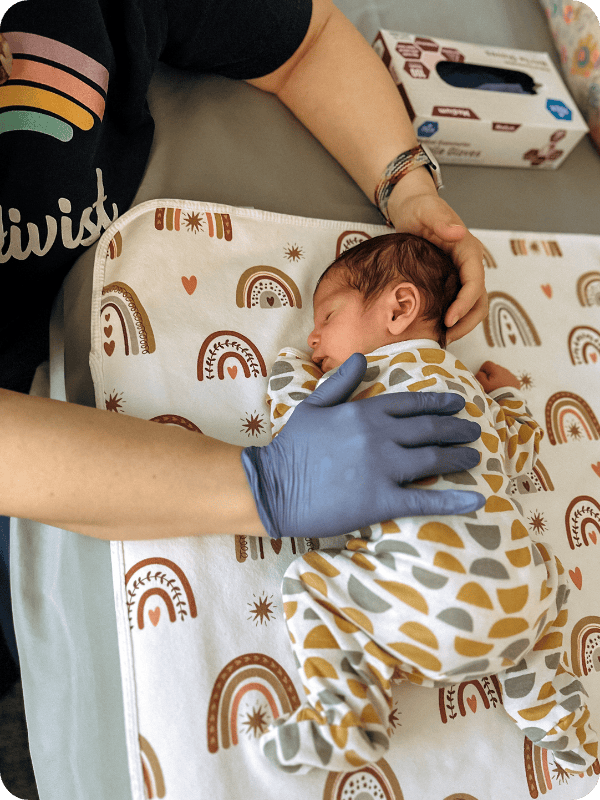
An evaluation by a physical therapist, occupational therapist, and/or craniosacral therapist trained in flat spots and neck and body tension is recommended. They can assess the underlying cause for formation of a flat spot and help you help your little one at home.
You can discuss your concerns with your child’s pediatrician, but please remember that they are not specialists in this area. If you express your concerns and feel dismissed, trust your gut! If necessary, seek a second opinion from a trained therapist or even get a free consultation from places like Cranial Technologies or a Hanger Clinic.
You deserve to have all the information you need to make an informed decision about how to help your little one. Equipping yourself with all the information to make the decision that’s best for your family is worth it!
More parenting support
Parenting is hard, and Eat Play Say is here to help. Our team of child specialists has put together so many resources to help you kick Google to the curb and parent with confidence.
You can find more posts about infant and toddler development, breast & bottlefeeding, and starting solids on our blog!
For our most in-depth resources, check out our Handbooks. Our guides have hundreds of pages of searchable, screenshot-able tips and education written by our experts!
And remember, you’ve got this.
Sources
- Unnithan AKA, Sina RE. Plagiocephaly. [Updated 2025 Dec 13]. In: StatPearls [Internet]. Treasure Island (FL): StatPearls Publishing; 2026 Jan-. Available from: https://www.ncbi.nlm.nih.gov/books/NBK564334/#
- Collett B, Breiger D, King D, Cunningham M, Speltz M. Neurodevelopmental implications of “deformational” plagiocephaly. J Dev Behav Pediatr. 2005 Oct;26(5):379-89. doi: 10.1097/00004703-200510000-00008. PMID: 16222180; PMCID: PMC3393045.
- ÖHMAN, A., NILSSON, S., LAGERKVIST, A.-L. and BECKUNG, E. (2009), Are infants with torticollis at risk of a delay in early motor milestones compared with a control group of healthy infants?. Developmental Medicine & Child Neurology, 51: 545-550. https://doi.org/10.1111/j.1469-8749.2008.03195.x
OTHER POSTS YOU MAY LIKE:




MS, SLP
Founder of Eat Play Say, Speech-Language Pathologist, Feeding Specialist, Play Expert, Mom of 3
Jordyn Koveleski Gorman
SPECIALIZES IN: Infant and toddler speech-language, play, and feeding development, and curating a team that provides expert help that feels like a reassuring text from that one mom friend
EDUCATION: Jordyn received her BS in Speech-Language Pathology from Bloomsburg University and her MS in Speech-Language Pathology from Towson University
FAVE PARENTING FIRST: “The first true smile, it’s the sweetest!”

MS, CCC-SLP, CBS, IBCLC
Speech-Language Pathologist & Feeding Specialist, Certified Breastfeeding Specialist, International Board Certified Lactation Consultant
Jessica Nicholson Cocca
SPECIALIZES IN: Breast and bottle feeding, tongue ties, oral motor dysfunction, starting solids, infant and toddler speech, treating oral motor disorders
EDUCATION: Jessica received her BS in Communication Sciences and Disorders from Pennsylvania State University in 2015 and her MS in Speech-Language Pathology from Towson University in 2017
FAVE PARENTING FIRST: “Baby’s first wave! What a fun first communication gesture!”

MA, CCC-SLP, CLC
Speech-Language Pathologist, Certified Lactation Counselor
Jennifer McFarlin
SPECIALIZES IN: Breast and bottle feeding, tongue ties, starting solids, infant and toddler speech development
EDUCATION: She received her BS in Speech-Language Pathology from Ball State in 2014 and a MA in Speech-Language Pathology from Ball State in 2016.
FAVE PARENTING FIRST: “My favorite baby’s first is their first true smile that just warms your soul knowing they are smiling at you. My other favorite is their first word. I love watching their language explode!”

MS, CCC-SLP
Bilingual Speech-Language Pathologist
Nicole La Petina Kelly
SPECIALIZES IN: Bilingual development (Spanish-English), supporting multilingual families, infant and toddler speech
EDUCATION: She received her BA in Communication Sciences and Disorders and in Spanish from the University of Wisconsin-Madison in 2014 and her MS in Speech-Language Pathology with an English-Spanish Specialization from Marquette University in 2016.
FAVE PARENTING FIRST: “It’s the first slobbery kisses for me!”

RDN, LD
Licensed Registered Dietitian
Kimberly Vede
SPECIALIZES IN: Infant and pediatric nutrition including breastfeeding, formula feeding, and starting solids. She also specializes in prenatal and postpartum nutrition.
EDUCATION: She received her BSc in Biology in 2014 from Life University, and her BSc in Dietetics from Life University in 2019.
FAVE PARENTING FIRST: ”The first time they say ‘mama!’”


This checklist was created with input from a Speech-Language Pathologist, Occupational Therapist and Physical Therapist and has been downloaded over 20,000 times by parents worldwide. Learn the important milestones to pay attention to, and keep it in your digital back pocket during the baby + toddler years!
Comprehensive Milestone Checklist for gross motor, fine motor, and speech-language milestones for 0-36 months,
DOWNLOAD FOR FREE


