


Light Up Toys: Are They Bad for Development?
December 3, 2024
Jordyn Koveleski Gorman

Last Updated on March 10, 2026 by Jordyn Koveleski Gorman
This page contains affiliate links. We will receive a commission on qualifying purchases using these links.
As with many things, the internet is divided about light up toys. Specifically, the debate seems to center around light up toys versus wooden, non-battery operated toys. This discussion gets heated to say the least.
If you’re feeling unsure, taking time to review the research and learning how we can interpret it can provide a lot of clarity. Also, it’s important to remember that, although research is helpful and lays the foundation for recommendations and clinical practice, it is not the end-all be-all. What works for one family will not work for every family. And that’s okay! Grains of salt are everywhere, so let’s take them with us on this journey.
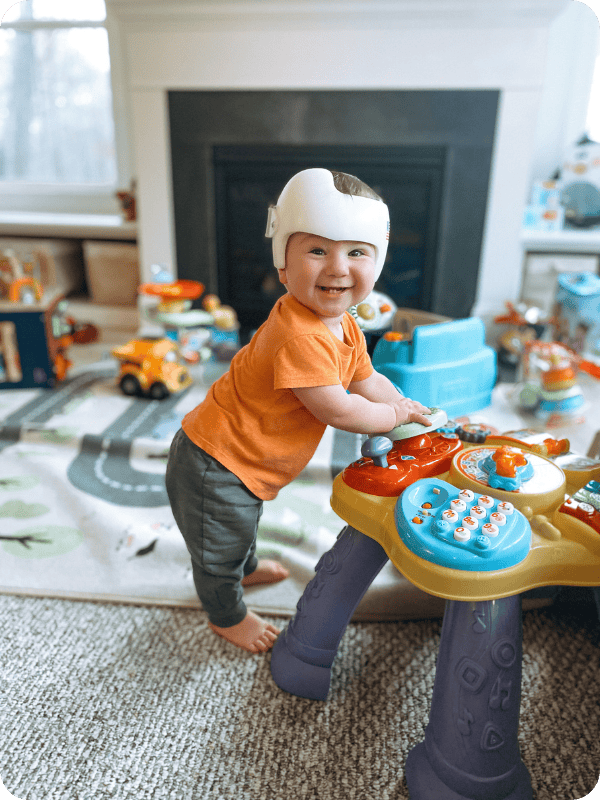
Light up toys and development
So why do people say that light up toys “cause” language delays?
Most of the time, this is referring to a 2015 study from JAMA Pediatrics. The study found that “infants who play with tech toys featuring flashing lights and computerized talking and music, instead of traditional wooden playthings, tend to have a decreased quality and quantity of language.” (1)
No wonder people have jumped straight to tossing their light up toys in the dumpster. Reading that one sentence, it’s reasonable to see why people may immediately jump to thinking these toys cause babies not to talk!
But that one sentence isn’t the entire picture. The article continues: “While playing with electronic toys there were fewer adult words used, fewer conversational turns with verbal back-and-forth, fewer parental responses and less production of content-specific words than when playing with traditional toys or books.” (1)
That means that parents were less likely to talk to their little one while they were playing with a light up toy. The toy wasn’t causing less communication from the child. Instead, the toy was impacting how parents engaged with their child.
Is there an argument to be made that wooden toys that don’t make sounds or have music are more likely to prompt a caregiver to sing, model sounds, or fill the silence with their own voice? Absolutely. Are wooden, “open-ended,” and silent toys more likely to prompt a parent to interact with their baby? Maybe!
But are light up toys causing babies not to talk? No. They might be discouraging a parent from using their own voice during play routines, and that’s something important to know.
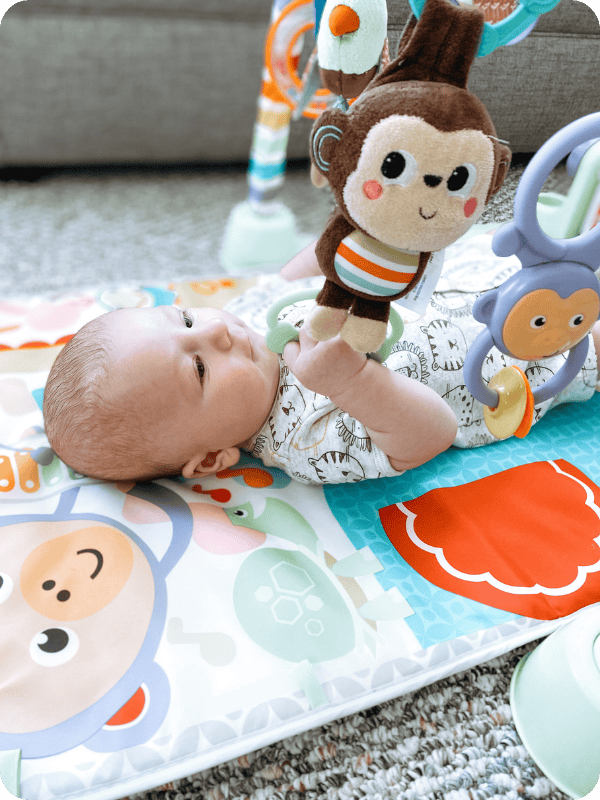
Playing with a light-up toy
If light up toys don’t directly cause language delays, then what’s the best way to play with them?
Toys that sing songs or light up always seem to be marketed as “great for independent play,” which gives the parent the idea that most or all play should be independent. Or it pushes the idea that independent play should be the ultimate goal.
It’s not.
Learning is the ultimate goal.
There is nothing inherently wrong with toys that stimulate your child and motivate them to press buttons to hear fun sounds. But should we encourage littles to play alone with those toys as their primary way of play?
Given what the research says, I don’t think so. These toys are actually best played with when a caregiver is present.
Knowing that light up toys can limit language interactions between parents and babies, the way to counteract that would be to intentionally get involved. Since there is a risk for less language to be spoken, parents can be aware of that and make a conscious effort to model and engage more with those toys.
As a general rule of thumb, we recommend that you play together first, play independently second. Especially in early infancy, a good overall balance of playing with your child and letting them explore should be the goal. Babies can best play independently once they have played with you. By modeling concepts, language, and actions to them first, they are better able to try things on their own!
And yes, we all need a few minutes to use the restroom, chop some fruit, or fold the laundry. It is totally reasonable and developmentally appropriate to let your little one play alone. Yes, even with battery-operated and light up toys! If your little one is on a mission to play with something and is focused and engaged alone, that’s awesome! Leave them be and wait for them to come back and find you to play. Trust me, they’ll come back!
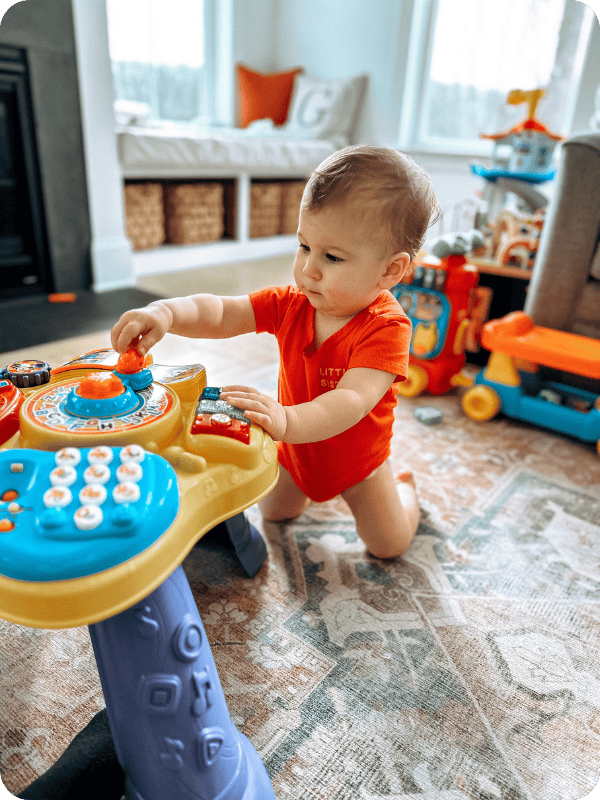
Light up toys for infants
So maybe light up toys aren’t all that bad. But are some better than others? Absolutely! As child development specialists, the Eat Play Say team has tested a lot of toys over the years. Some of our favorite options are even used in clinical settings to help keep littles engaged when practicing different skills.
You’ll even find that several of our picks for the best developmental toys light up and play sounds! Remember, it’s more about how you play with them than what your little one is playing with!
Light up bath toys
This set of light up sensory cubes is a great choice for bath time. Obviously, bath time is an event that requires a lot of parent involvement and supervision anyway. This is a great time to model action words and colors to older toddlers. Infants are likely to enjoy watching how the colors change the water and how they move around.
Bath toys with batteries can be a little sketchy, and avoiding mold growth is always a big priority. These check off both boxes for safety! We have more of our favorite bath toy recommendations here.
Light up spinner toys
There are a few great options for light up toys that have spinning features. For littles under the age of 1, toys like this press and glow spinner or this light up aquarium help model cause and effect. You can model pressing the button, saying things like “push!” and “whoosh!” as the toy lights up.
This sensory spinner can be really helpful for playtime on the go, since it suctions to the hair chair, table, or stroller. It can also be used as a tool to help encourage littles to pull to stand and to work on reaching across their body!
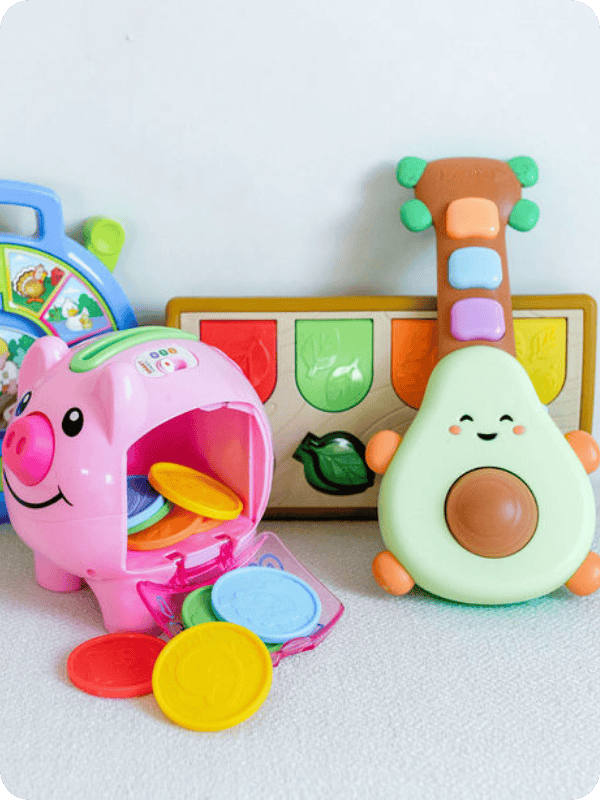
Light up sensory toys
By nature, light up toys are sensory toys. A few of our favorites that help provide sensory experiences for little ones are:
This light activity board is perfect for at home or on-the-go. You can model words like “on,” “off,” and even “push” or “pull.” Practice showing your little one things like a “button” or “keys,” too! As your little one grows into toddlerhood, this becomes an excellent tool for modeling colors naturally. You can say things like “That light is red!” or “Can you turn on the blue light?”
This little bumble bee toy is perfect for babies who are about to start crawling or are already crawling. It’s a great tummy time toy that grows with your child as they go from immobile to full-blown crawling around you in circles. They can chase it around the floor and build their strength, too! Model words like “stop” and “go” while playing with toys like this with your child.
Musical toys are great for development (and picking up on musical skills can help support early language skills, too!). This “Rock-a-Mole” guitar has been a favorite from ages 3m–18m! There are multiple ways to engage with the toy, from pressing the light up buttons to wiggling the ball around. And musical table toys can provide various opportunities for modeling speech, singing, playing different musical sounds, and, of course—lights!
Need more help with play activities?
So now you know that light up toys aren’t bad, and the way you play with your little one makes all the difference. Maybe you’re wondering how to actually play with your child in age-appropriate ways. You’re not alone!
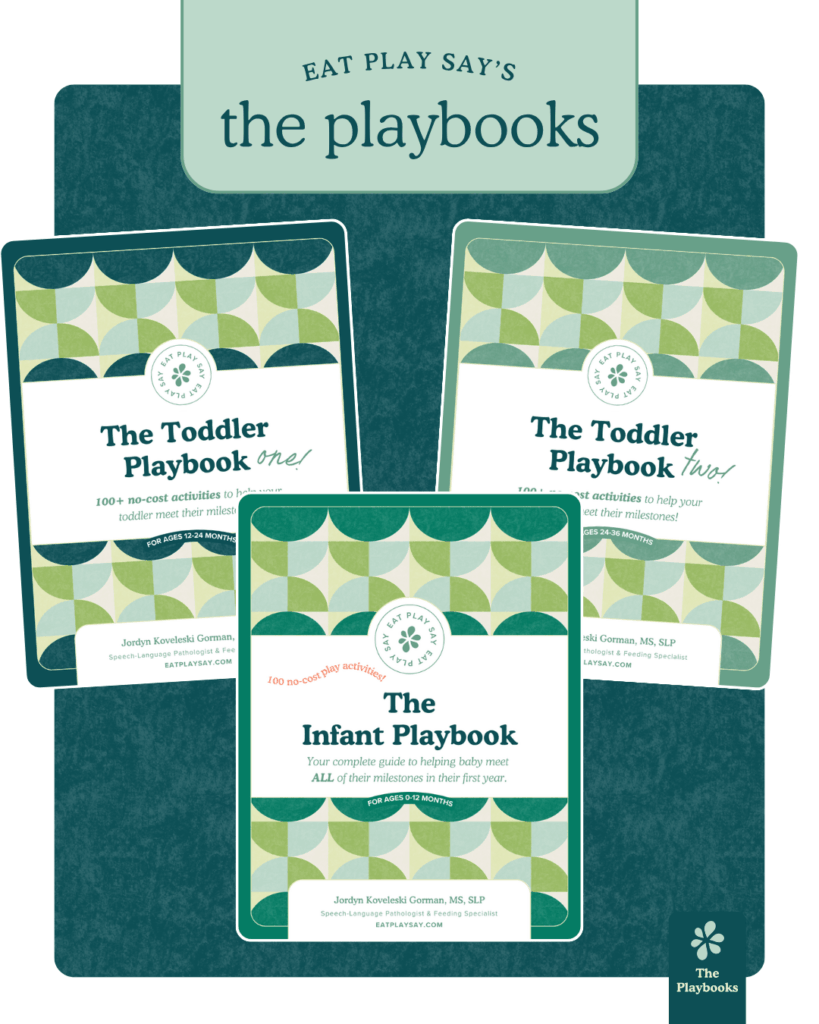
That’s why we created our Playbooks. The activities inside help your little one meet their milestones through play using only what you have at home. With more than 100 activities in each ebook, the guides break down activities for each age that support speech, fine motor and gross motor skill development.
Sources
- “Association of the Type of Toy Used During Play With the Quantity and Quality of Parent-Infant Communication” by Anna V. Sosa, PhD in JAMA Pediatrics. Published online December 23 2015 doi:10.1001/jamapediatrics.2015.3753
OTHER POSTS YOU MAY LIKE:


MS, SLP
Founder of Eat Play Say, Speech-Language Pathologist, Feeding Specialist, Play Expert, Mom of 2
Jordyn Koveleski Gorman
SPECIALIZES IN: Infant and toddler speech-language, play, and feeding development, and curating a team that provides expert help that feels like a reassuring text from that one mom friend
EDUCATION: Jordyn received her BS in Speech-Language Pathology from Bloomsburg University and her MS in Speech-Language Pathology from Towson University
FAVE PARENTING FIRST: “The first true smile, it’s the sweetest!”

MS, CCC-SLP, CBS, IBCLC
Speech-Language Pathologist & Feeding Specialist, Certified Breastfeeding Specialist, International Board Certified Lactation Consultant
Jessica Nicholson Cocca
SPECIALIZES IN: Breast and bottle feeding, tongue ties, oral motor dysfunction, starting solids, infant and toddler speech, treating oral motor disorders
EDUCATION: Jessica received her BS in Communication Sciences and Disorders from Pennsylvania State University in 2015 and her MS in Speech-Language Pathology from Towson University in 2017
FAVE PARENTING FIRST: “Baby’s first wave! What a fun first communication gesture!”

MA, CCC-SLP, CLC
Speech-Language Pathologist, Certified Lactation Counselor
Jennifer McFarlin
SPECIALIZES IN: Breast and bottle feeding, tongue ties, starting solids, infant and toddler speech development
EDUCATION: She received her BS in Speech-Language Pathology from Ball State in 2014 and a MA in Speech-Language Pathology from Ball State in 2016.
FAVE PARENTING FIRST: “My favorite baby’s first is their first true smile that just warms your soul knowing they are smiling at you. My other favorite is their first word. I love watching their language explode!”

MS, CCC-SLP
Bilingual Speech-Language Pathologist
Nicole La Petina Kelly
SPECIALIZES IN: Bilingual development (Spanish-English), supporting multilingual families, infant and toddler speech
EDUCATION: She received her BA in Communication Sciences and Disorders and in Spanish from the University of Wisconsin-Madison in 2014 and her MS in Speech-Language Pathology with an English-Spanish Specialization from Marquette University in 2016.
FAVE PARENTING FIRST: “It’s the first slobbery kisses for me!”

RDN, LD
Licensed Registered Dietitian
Kimberly Vede
SPECIALIZES IN: Infant and pediatric nutrition including breastfeeding, formula feeding, and starting solids. She also specializes in prenatal and postpartum nutrition.
EDUCATION: She received her BSc in Biology in 2014 from Life University, and her BSc in Dietetics from Life University in 2019.
FAVE PARENTING FIRST: ”The first time they say ‘mama!’”


This checklist was created with input from a Speech-Language Pathologist, Occupational Therapist and Physical Therapist and has been downloaded over 20,000 times by parents worldwide. Learn the important milestones to pay attention to, and keep it in your digital back pocket during the baby + toddler years!
Comprehensive Milestone Checklist for gross motor, fine motor, and speech-language milestones for 0-36 months,
DOWNLOAD FOR FREE


